
What Lives in Your Lungs When You Can't Cry
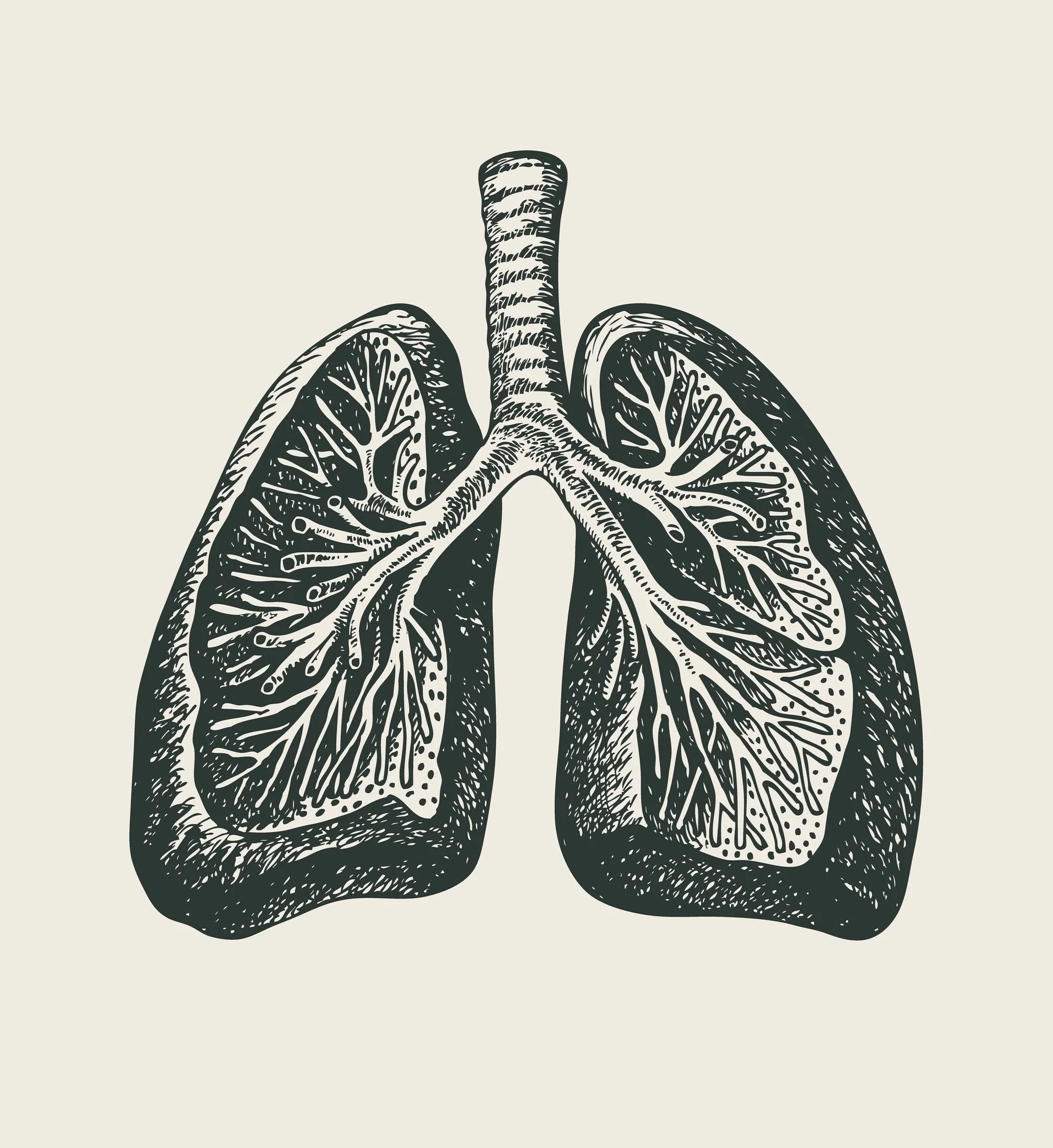
The secret weight of grief, longing, and everything left unsaid
This is the final article in the series, Decoding the Secret Language of Your Body. We've moved through the heart, the gut, the thyroid, the liver, the skin. Now we arrive at the lungs—where breath and spirit share the same name.
You enter this world on an inhale. You leave it on an exhale.
Between those two breaths, the lungs record everything. Every sob you swallowed. Every word you couldn't say and all the moments you braced against life instead of breathing it in. The lungs are the body's threshold keepers—holding the space between what you take in and what you let go, between self and world, life and death.
No other organ sits at this edge. No other organ touches the outside world with every beat of its rhythm. The lungs are where your spirit meets the air—where grief settles, fear constricts, and where joy opens you back up.
When the lungs struggle, it's rarely about oxygen. It's about everything you couldn't let in and couldn't release. The breath you've been holding is the life you've been afraid to claim.
The Lungs: The Only Organ That Touches the Outside World
Your lungs form the primary boundary between self and world. With every breath, you allow something that is not you—air, particles, scent, temperature—into the most delicate interior spaces of your body.
Breathing is relationship. Inhaling requires openness. You cannot filter, control, or fully predict what enters. You receive first, then decide whether to tighten or soften around that contact. This is why the lungs link so strongly to grief, fear, and trust: when the world has felt unsafe, the lungs learn to restrict intimacy. When safety returns, breath deepens.
The state of the lungs reflects how willing the body is to meet life as it is. When you struggle to let life in, your lungs show it first.
The Mind-Body Connection: What Science Reveals About Breath and Emotion
Your lungs have their own neural network—an emotional brain that senses internal shifts before your conscious mind catches up. Their electrical rhythms influence how fear circuits fire, how memories consolidate, how intuition sharpens. Every breath subtly rewires the timing of your emotional and cognitive processes.
During trauma, the lungs change shape. The breath shortens. The rib cage stiffens. Oxygen flow narrows so you can become small and protected. These patterns persist long after the threat passes. Your chest tells the truth even when your mind insists otherwise.
Research shows the lungs generate rhythmic electrical pulses that guide the heart and influence the intuitive centers of the brain. Calm breathing enhances clarity and perception. Erratic breath clouds intuition and heightens reactivity.
Breath also shapes your electromagnetic field. Every expansion and contraction shifts the field around your body. When breath collapses, the field collapses with it.
Yet the lungs are remarkably regenerative. They rebuild alveoli, repair tissue, restore elasticity when conditions allow. It seems as if hope is built into their design.
How Language Reveals What the Body Already Knows
We've been speaking the lungs' truth all along:
I need room to breathe. It took my breath away. I've been holding my breath. Don't hold your breath. A breath of fresh air. I was left breathless. She finally exhaled. I couldn't catch my breath.
The lungs are where we feel overwhelm, relief, anticipation, and release. The body's been speaking, but are we listening?
Each Lung Carries Its Own Emotional Story
The left lung holds your earliest imprints—your family's emotional climate, the air you learned to breathe as a child, the needs no one met.
The right lung carries your adult terrain: the losses you've endured, the partnerships you've navigated, the weight you've carried alone.
The Emotional Patterns Stored in Your Lungs
Grief and the Lungs
Grief fills the chest like wet sand—dense, unyielding, impossible to ignore. Each breath turns into labor. The inhale shortens. The airways narrow. The body begins to ration breath, as if oxygen itself has become scarce. The lungs work harder to move less air, and the nervous system settles into a low-grade state of suffocation.
With prolonged grief, the diaphragm loses its natural descent. The chest wall stiffens and stops yielding to expansion. Breath retreats upward, shallow and guarded. The lungs do not open fully because the body no longer trusts depth. Tissue tightens. Movement becomes economical. The body adapts to carrying sorrow without release.
Sadness and the Breath
Sadness arrives quietly, settling into the lungs like a fine gray mist, dulling sensation. Breath grows heavy. Each inhale meets resistance; each exhale releases too little. What was never spoken—loss, pain, unshed tears—lingers in the tissues, pulling the breath downward and asking the body to contain what it never had space to express.
Over time, sadness lowers the ceiling of the chest. The ribcage stiffens. The diaphragm hesitates, then forgets how to descend. The lungs stop reaching for expansion. Restraint becomes routine.
Longing and the Chest
Longing feels like a wound that never fully closes—tender, sore, pulling the breath forward toward something just out of reach. The inhale stretches. The exhale never quite completes. The body waits in anticipation, suspended between desire and arrival.
Longing is a door held open for someone who isn't coming. The heart-lung space stays tense. The diaphragm remains partially lifted. The nervous system hovers, alert but unresolved. Longing becomes the ache for connection, for love given and lost.
Joy and the Breath
Joy is pure light—the expression of spirit embodied in human form. It glows. Expansive. Alive. Warmth spreads through the chest, lifting the lungs and opening the heart center.
Breath deepens on its own. The nervous system softens. Muscles release their grip. Chemistry shifts as signals of safety travel through the bloodstream—serotonin, dopamine restoring rhythm and balance.
This is the body in agreement with itself. A natural state of balance. The remembered harmony of body, mind, and soul.
Why Breathwork Works for Emotional Healing
Breath is the fastest way to transform your brain. A single shift in your breath rhythm can alter vagal tone, neural timing, electrical conductivity, and state of consciousness. This is why visions emerge in breathwork and why tears rise without warning. Breathwork restores flow and balance.
Metaphysically, the lungs are threshold keepers. They hold the in-between spaces: life and death, self and other, past and future, the known and the not-yet-known. Breathwork opens altered states because breath rests at this doorway.
Your lungs know exactly what you've been holding and what needs to release.
The Six Patterns of Lung Dysfunction: What Your Body May Be Telling You
Asthma: When the Body Fears Taking Up Space
Asthma often reflects a lifelong pattern of restricting breath—not just physically, but emotionally. It tends to emerge in those who grew up scanning for tension, conflict, or unpredictable energy, where breathing freely felt unsafe. The lungs tighten when there is a fear of fully occupying your space, of expressing needs, or of allowing life all the way in. There is usually a thread of inherited anxiety, hypervigilance, or unresolved grief woven into the pattern.
Asthma flares when the body anticipates overwhelm. Breath becomes shallow when the nervous system expects intrusion, criticism, or disappointment. For many, this began in childhood homes where emotions ran high, or where sensitivity was dismissed. The lungs respond by bracing—a protective mechanism that becomes chronic. Asthma is the body's way of saying: I'm trying to live, but something inside me is still bracing for impact.
Reflection Questions
Where in my life do I still shrink or brace instead of breathe freely?
Whose emotions or expectations am I still carrying in my chest?
What grief have I never fully allowed myself to release?
What would it feel like to take up more space without apology?
Bronchitis: When Unspoken Truth Strains the Breath
Bronchitis often appears when someone carries emotional weight they never voice, forcing the lungs to hold what the heart won't release. The bronchi—the airways that deliver breath—tighten and inflame under the pressure of unexpressed truth, chronic over-responsibility, and the belief that your needs come last.
This condition frequently shows up in caregivers, parents, peacemakers, and those who feel responsible for stabilizing others. You may swallow irritation to avoid conflict, hide sadness to stay strong, or silence instincts to keep the peace. Over time, the body protests.
The cough becomes the voice you didn't use. The inflammation becomes the boundary you didn't set. The breath becomes a negotiation between survival and suppression.
Bronchitis invites a reckoning: What truth is stuck at the threshold of your voice? What are you carrying that was never yours?
Reflection Questions
What emotions am I holding that I've never spoken aloud?
Where am I still carrying responsibility that drains my breath?
What conversation have I been avoiding because I fear the outcome?
What would my lungs say if they could speak the truth for me?
COPD: When Grief Becomes the Air You Breathe
COPD reflects years of unprocessed grief, swallowed truths, and the chronic fear of taking up space. The lungs hold unresolved sorrow—the kind you learned to manage instead of feel. When the body can no longer carry that emotional weight, the breath becomes restricted. The lungs tighten around the pain you never had permission to release.
This pattern appears in people who spent their lives being "the strong one," the stabilizer, the one who absorbed more than they could metabolize. Over-responsibility becomes a way of breathing. Self-denial becomes automatic. Eventually, the lungs collapse under the emotional load, mirroring the internal sense of being suffocated by duty, past losses, or unspoken despair.
At its core, COPD signals a life lived in emotional bracing—guarding the heart while starving it of oxygen.
Reflection Questions
What grief have I never allowed myself to fully feel?
Where have I carried responsibility that was never mine?
What emotions surface when I slow down and breathe deeply?
What part of me believes I don't have the right to take up space?
Cystic Fibrosis: The Grief of Generations
Cystic fibrosis carries the emotional imprint of a life that never felt spacious enough to breathe. It often forms in lineages where grief was never named, love was conditional, and emotional expression felt dangerous or forbidden. The lungs, the organ of receiving, tighten around inherited sorrow. The pancreas, the organ of nourishment, contracts around unmet needs. This is a body born into density that was never spoken aloud.
This pattern emerges when the family system has carried generations of unprocessed grief, suffocation, and emotional constriction. The child arrives already holding what their lineage could not metabolize: grief so thick it becomes mucus, expectations so heavy they become pressure, sorrow so silent it becomes the difficulty to take in breath.
CF mirrors a deeper story: a lineage that learned to hold everything in. To swallow pain. To survive by tightening. Every labored breath echoes the collective exhale the family never took. And yet, beneath it all, there is extraordinary strength. These souls often incarnate with a profound mission of transmutation—to break open a system that has survived in silence for far too long.
Reflection Questions
What grief in my family line was never spoken, acknowledged, or witnessed?
Where did I learn to brace, contract, or hold my breath around my deepest needs?
What emotions am I still carrying for others that my body no longer has capacity to store?
Tuberculosis: The Wound That Never Found Air
Tuberculosis often reflects a lifetime of holding your breath—emotionally, spiritually, and physically. It appears in people who lived through suffocating environments where truth wasn't safe and expression carried consequences. You learned early that silence kept you alive. So you inhaled fear, swallowed grief, and hid the parts of yourself that wanted to speak or expand. The lungs, built for openness, became chambers of unspoken memory.
This condition often develops when an old emotional wound remains sealed off—something you never processed, something you kept locked inside because naming it felt dangerous, disloyal, or too painful to face. The body, still carrying the imprint of that compression, begins to collapse inward—mirroring the original wound.
Tuberculosis symbolizes a deeper spiritual exhaustion: the feeling of being drained by a lifetime of carrying what was never voiced. The breath becomes thin because the self has been thinned.
Reflection Questions
What truth have I been holding that never found breath?
Where did silence become my survival strategy?
What grief or fear still lives in the chambers of my chest?
What would it feel like to breathe without hiding?
Lung Cancer: When Unspoken Truth Becomes Internal Erosion
Lung cancer carries the weight of years spent swallowing truth to keep the peace. It often arises in people who learned early that their voice was dangerous or unwelcome—those who silenced their needs to avoid conflict, rejection, or abandonment. The lungs are the organ of receiving and releasing. When someone lives in survival mode, constantly bracing for impact, breath becomes shallow and expression constricts.
This condition reflects a life lived without enough room for authenticity. You've inhaled expectations, responsibilities, and obligations that were never yours. You've exhaled your truth so many times that your body can no longer locate it. Lung cancer emerges where the core self has been consistently overridden—where grief, resentment, or suppressed desire has no outlet but the tissue itself.
This is the body revealing how much it's carried alone. The lungs asking for spaciousness, for truth.
Reflection Questions
What truth have I denied to keep others comfortable?
Where have I replaced my own needs with duty or obligation?
What part of my identity has been suffocating beneath silence?
How to Begin Healing: A Simple Breathing Practice
Your lungs have been speaking. Tightening. Holding. Waiting for you to finally exhale what you've been carrying too long.
When you finally listen—when you let the grief move, speak the truth, release the weight—the body responds. The chest opens. The breath deepens. The lungs remember how to receive.
When you wake each morning, greet the day with a breath from the diaphragm. One hand on your chest, one on your belly. Breathe deeply. Let go. Repeat. Just be with your breath. That is your true essence—coming home, connecting with your spirit.
A beautiful ritual to close the day is one and the same. A beginning and an end, connected through breath. Breathe deeply. Feel your blood, your body, your tissues shifting—releasing rigidity, surrendering tension. Ease. Smoothness. Warmth. Expansion. All with just a breath. No elaborate ritual. No cost. It's there for you.
As you walk in nature, notice the architecture of the trees—the twists and turns of the branches, the patterns they form. Your lungs mirror the tree in shape and function. The leaves create oxygen for the world, just as your breath creates oxygen for your inner world. The inner reflects the outer.
You don't have to keep holding it all in. Your lungs are ready to release the moment you are.
Check in with your body. And breathe.
Work With Me
If your body is speaking through chronic skin conditions, unexplained symptoms, or persistent inflammation, I can help you decode what it's trying to tell you. Through medical intuitive readings and somatic healing sessions, we'll identify the emotional patterns underneath your physical symptoms and create a personalized path to healing. Book a Medical Intuitive Reading or Discovery Call.
You can read the rest of the series here:
Your Body is Recording Everything You Think
The Secret Language of the Heart: When Emotions Become Illness
Your Gut Knows Before You Do: How the Body Stores Trauma, Truth, and Power
The Thyroid's Secret: What Your Silenced Voice is Trying to Tell You
Where Resentment Rests: Decoding the Liver's Emotional Burden